
Money Market Fund vs Money Market Account: 2026 Yield Guide
Discover the key differences in a money market fund vs money market account for 2026, including safety, yield potential, and FDIC insurance protections.
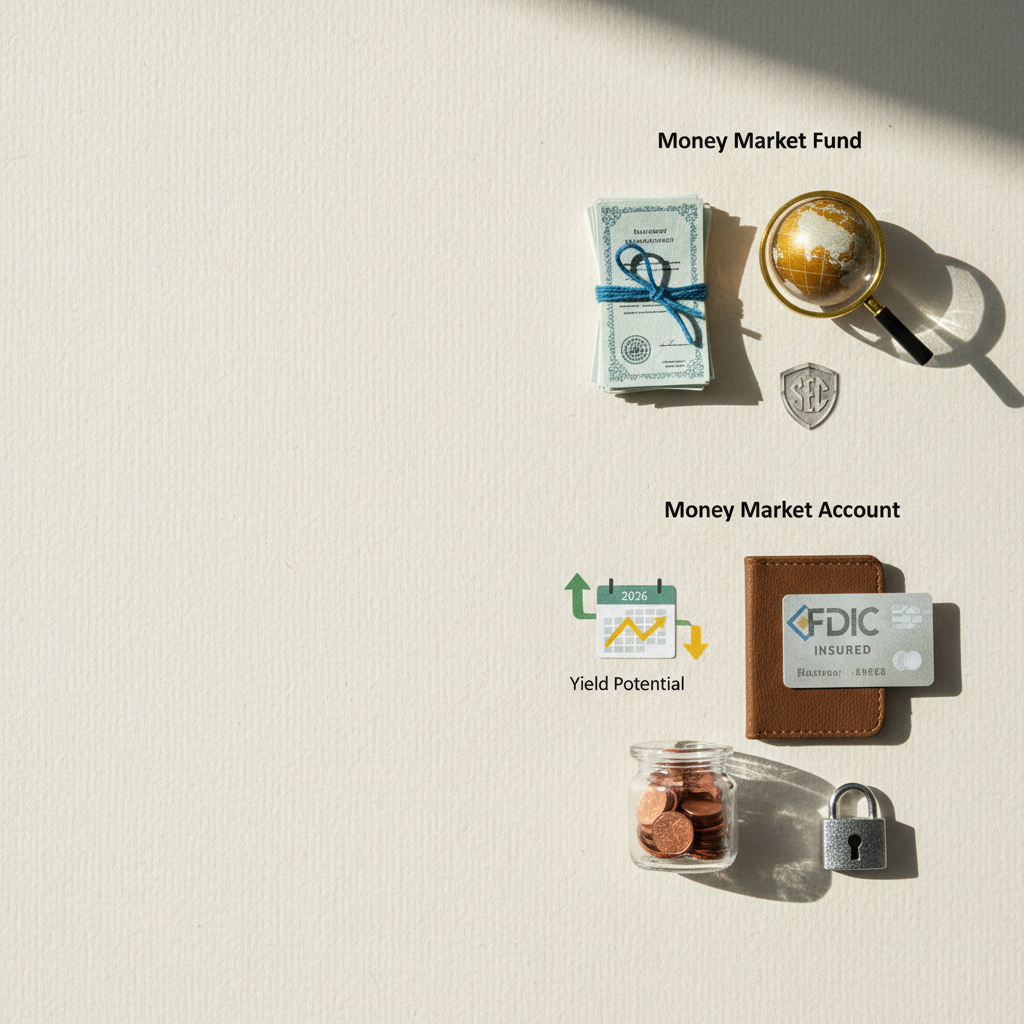
Understanding the distinction between a money market fund vs money market account is essential for any consumer looking to maximize their cash holdings in 2026. While the names are remarkably similar, these two financial vehicles operate in entirely different regulatory ecosystems. One is a banking product designed for stability and accessibility, while the other is an investment product tailored for slightly higher yield through short-term debt instruments. Navigating these options requires a clear grasp of how your money is protected and how it grows.
What is a money market account? A money market account (MMA) is a type of interest-bearing savings account offered by banks and credit unions. It is often referred to as a "hybrid" because it combines the features of a traditional savings account with the transactional flexibility of a checking account. MMAs typically offer higher interest rates than standard savings accounts but may require a higher minimum balance to waive monthly maintenance fees.
In early 2026, many consumers are turning to MMAs to park their emergency funds because they offer immediate liquidity. These accounts are also frequently used for larger, upcoming expenses like a home down payment or a wedding. Because they are bank-issued instruments, they come with federal protections that make them one of the safest places to store cash. When looking at a money market fund vs money market account, the primary allure of the account is the peace of mind provided by deposit insurance.
How does a money market fund differ from an account? A money market fund is a type of mutual fund that invests only in highly liquid, short-term debt securities. These include U.S. Treasury bills, certificates of deposit (CDs), and commercial paper. Unlike a bank account, a money market fund is an investment product offered by brokerage firms and mutual fund companies. When you put money into a fund, you are purchasing shares of that fund, rather than making a deposit into a bank ledger.
While the goal of a money market fund is to maintain a stable net asset value (NAV) of $1.00 per share, this is not guaranteed by the government. The money market fund vs money market account debate often hinges on this distinction: one is a deposit, while the other is a security. Investors who prioritize yield over absolute government guarantees often favor funds, especially when the yield spread between market-based instruments and bank deposits widens.
Is my money safe in a money market account? Yes, money market accounts at federally insured institutions are among the safest places to keep your money. They are protected by the Federal Deposit Insurance Corporation (FDIC) at banks or the National Credit Union Administration (NCUA) at credit unions. This insurance covers up to $250,000 per depositor, per insured institution, for each ownership category. This protection is a core feature for those deciding on high-yield cash options, similar to how one might evaluate are high yield savings accounts FDIC insured?.
According to the FDIC's National Rates and Rate Caps, even if a bank were to fail, the federal government stands behind the balance of your MMA up to the legal limit. This makes the MMA a virtually zero-risk option for risk-averse savers. In 2026, with continuing market volatility, this layer of federal protection remains a major selling point for those who cannot afford to lose a single penny of their principal.
Is my money safe in a money market fund? Money market funds are not insured by the FDIC or NCUA. Instead, they are regulated by the Securities and Exchange Commission (SEC) under Rule 2a-7 of the Investment Company Act of 1940. While they are considered low-risk investments, there is a theoretical possibility that the NAV could drop below $1.00, an event known as "breaking the buck."
However, most brokerage accounts are protected by the Securities Investor Protection Corporation (SIPC). It is important to note that SIPC does not protect against investment losses; it protects against the loss of cash and securities held by a customer at a financially troubled brokerage firm. For those seeking absolute safety of principal, a bank-based MMA is superior, but for those comfortable with minimal market risk, a fund is often preferred. To understand where these fit in a broader portfolio, many investors look at a 2026 strategy guide for low-risk investments.
What is a typical yield for a money market account in 2026? Yields on money market accounts fluctuate based on the Federal Reserve's monetary policy. In 2026, top-tier online banks are offering competitive APYs that frequently outpace the national average. While the Federal Reserve H.15 release tracks broader interest rate trends, banking consumers usually see MMA rates that lag slightly behind the Fed Funds Rate during a rising rate environment and fall quickly when rates are cut.
Many consumers use liquid MMAs as a bridge while waiting to commit to longer-term options, such as multi-year guaranteed annuities, which can lock in rates for several years. For individuals with significant balances, money market accounts offer a way to keep funds accessible while still earning more than a standard checking account.
| Account/Fund Type | Avg. Expected Yield | Minimum Balance | Insurance Type |
|---|---|---|---|
| Online Money Market Account | 4.45% | $500 | FDIC/NCUA |
| Prime Money Market Fund | 5.15% | $1,000 | SIPC (Brokerage) |
| Govt Money Market Fund | 4.85% | $0 | SIPC (Brokerage) |
| Brick-and-Mortar MMA | 0.65% | $2,500 | FDIC/NCUA |
Which offers better yields: funds or accounts? Generally, money market funds offer higher yields than money market accounts. This is because funds invest directly in the credit markets, whereas banks must maintain capital reserves and overhead for their branch networks. When market interest rates rise, money market funds tend to reflect those increases almost immediately. Conversely, bank MMA rates are set at the discretion of the institution and are often influenced by the bank's own need for deposits.
In 2026, the spread between the two can be as much as 50 to 100 basis points. For a large balance, this difference can result in hundreds of dollars in lost interest over a year. Those looking for maximum return on cash often gravitate toward funds or even explore how to buy Treasury bills to capture the highest possible government-backed yield.
How liquid are these two options? Both money market funds and money market accounts are considered highly liquid, but they function differently in day-to-day use. A money market account usually comes with a debit card and check-writing privileges. This makes it an ideal choice for someone who might need to pay a large bill or access cash at an ATM immediately. However, under the Federal Reserve's Regulation D, banks may still limit certain types of withdrawals to six per month, though many have relaxed these rules in recent years.
Money market funds are slightly less transactional. While many brokerages allow you to write checks against your fund balance, you cannot typically use a debit card at a grocery store directly from the fund. Redemption usually takes one business day (T+1) for the funds to settle in your brokerage cash sweep account. If you are comparing a high yield savings account vs a CD for your short-term needs, you'll find that MMAs and funds both offer significantly more flexibility than a certificate of deposit.
What are the tax implications? The interest earned on a money market account is taxed as ordinary income at the federal and state levels. In contrast, the taxation of a money market fund depends on the types of securities held within the fund. If you invest in a "Treasury" money market fund, the portion of the dividends derived from U.S. Government obligations may be exempt from state and local taxes, though still subject to federal tax.
For investors in high-tax states like California or New York, a Treasury money market fund can provide a higher "after-tax yield" than a bank MMA, even if the headline APY is lower. Understanding these nuances is a key part of any high yield savings account tax strategy. Always consult with a tax professional to see how specific fund distributions will affect your 2026 tax return.
Are there fees associated with these accounts? Money market accounts often come with monthly maintenance fees that can be waived if you maintain a minimum balance, which can range from $100 to $25,000. They may also charge fees for exceeding the monthly withdrawal limit or for using out-of-network ATMs.
Money market funds do not have monthly maintenance fees in the traditional sense, but they do have an expense ratio. This ratio represents the percentage of fund assets used to pay for management, administration, and marketing. For example, if a fund has an expense ratio of 0.20%, that amount is deducted from the fund's returns. When comparing a money market fund vs money market account, always look at the net yield (the yield after all fees have been subtracted) to get an accurate comparison.
Who should choose a money market account? A money market account is the best choice for individuals who prioritize safety and ease of use. If the money you are saving is meant for emergencies—like a medical bill or a car repair—you shouldn't have to worry about market fluctuations or one-day settlement delays. The FDIC insurance provides a psychological and financial safety net that investments cannot match. It’s also the right pick for those who prefer having their checking and savings under one roof for easier transfers.
Who should choose a money market fund? A money market fund is ideal for investors who already have a brokerage account and want a place to hold cash between investment trades. It is also a strong choice for those who are willing to accept a miniscule amount of risk in exchange for a higher yield. Because of the state-tax benefits of certain government-only funds, they are also a strategic tool for high-income earners looking to optimize their cash drag. If your goal is to find the best high-yield investments for 2026, a money market fund is a staple of a well-balanced portfolio.
Can you have both? Many savvy consumers use both a money market fund and a money market account as part of a tiered liquidity strategy. They might keep $10,000 in a bank MMA for immediate access and emergency needs, while keeping an additional $40,000 in a money market fund at their brokerage to earn a higher yield while waiting for a market opportunity. This approach ensures that you have the "best of both worlds": the absolute safety and transactional convenience of a bank, alongside the market-leading yields of a brokerage fund.
Summary of Key Factors - Safety: Accounts are FDIC-insured; funds are not, though they are highly regulated. - Yield: Funds generally offer higher yields by investing directly in credit markets. - Access: Accounts often include debit cards and ATMs; funds usually require a one-day settlement for transfers. - Taxes: Accounts are fully taxable; certain funds may offer state-tax exemptions. - Fees: Accounts have maintenance fees and minimums; funds have management expense ratios.
Frequently asked questions
- No. A money market fund is a mutual fund (an investment), while a money market account is a bank deposit account. They are regulated by different agencies and offer different levels of protection.
Final Considerations for 2026 As we move through the middle of 2026, the economic landscape continues to shift. While interest rates remain attractive for cash savers, the gap between the money market fund vs money market account remains wide enough to warrant a careful look at your monthly statements. If your bank is currently paying less than 3% on your MMA while brokerage funds are clearing 5%, it may be time to move your capital to a more productive home.
Before making a final decision, consider your upcoming cash needs. If you anticipate needing the funds within 24 hours for a surprise expense, the bank account is your best bet. If you are holding cash as a tactical move within your investment portfolio, the fund is the logical winner. By understanding these structural differences, you can protect your principal while ensuring your money is working as hard as possible in the current year's market.
Related articles
See all →
High Yield Savings vs Money Market Account: Which Is Best in 2026?
Discover the differences in the high yield savings vs money market account debate to find the best home for your cash and maximize your interest earnings in 2026.

The Tiered Liquidity Blueprint: Maximizing Money Market Utility
Learn how to structure your cash reserves using tiered money market strategies to capture peak yields while maintaining absolute liquidity for major expenses.

The Money Market Hybrid: Bridging Checking and Savings Rates
Discover how money market accounts combine liquidity and high yields to optimize your cash strategy in a fluctuating interest rate environment.

The MMA Premium: Quantifying the Return on Liquid Stability
A deep dive into why money market accounts currently offer a unique mathematical advantage over standard savings and CDs in a fluctuating rate environment.