Index Funds vs ETFs Explained: Choosing Your Strategy for 2026
Master the world of passive investing with index funds vs etfs explained for 2026. Discover which vehicle fits your tax strategy, budget, and long-term goals.
Sarah, a 32-year-old software project manager from Chicago, sat at her kitchen table in July 2026, staring at two open browser tabs. On one was a well-known mutual fund company’s index fund page; on the other was a popular brokerage showing an Exchange-Traded Fund (ETF). Both tracked the S&P 500. Both had nearly identical historical returns over the last decade. Yet, as she looked at her available cash, she felt a familiar paralysis. She knew she wanted to move away from low-yield options like those found in her savings account vs money market account 2026 guide and into something that could actually outpace inflation, but the technicalities of index funds vs etfs explained in most finance textbooks felt like legal jargon.
Sarah’s confusion is a rite of passage for almost every modern investor. In middle of 2026, the retail investing landscape has matured to a point where both index funds and ETFs are incredibly low-cost, but they operate with different mechanical gears under the hood. For Sarah, the decision wasn't just about what she was buying—the S&P 500—but how she was buying it. She needed to understand if she wanted the simplicity of an automated mutual fund or the flexibility and tax efficiency of an ETF.
This article will dive deep into the index funds vs etfs explained through Sarah's journey and the broader economic context of 2026. Whether you are looking to investing for the first time or rebalancing a mature portfolio, understanding the structural differences between these two powerhouses is essential for maximizing your after-tax wealth.
The Core Mechanics: Index Funds vs ETFs Explained
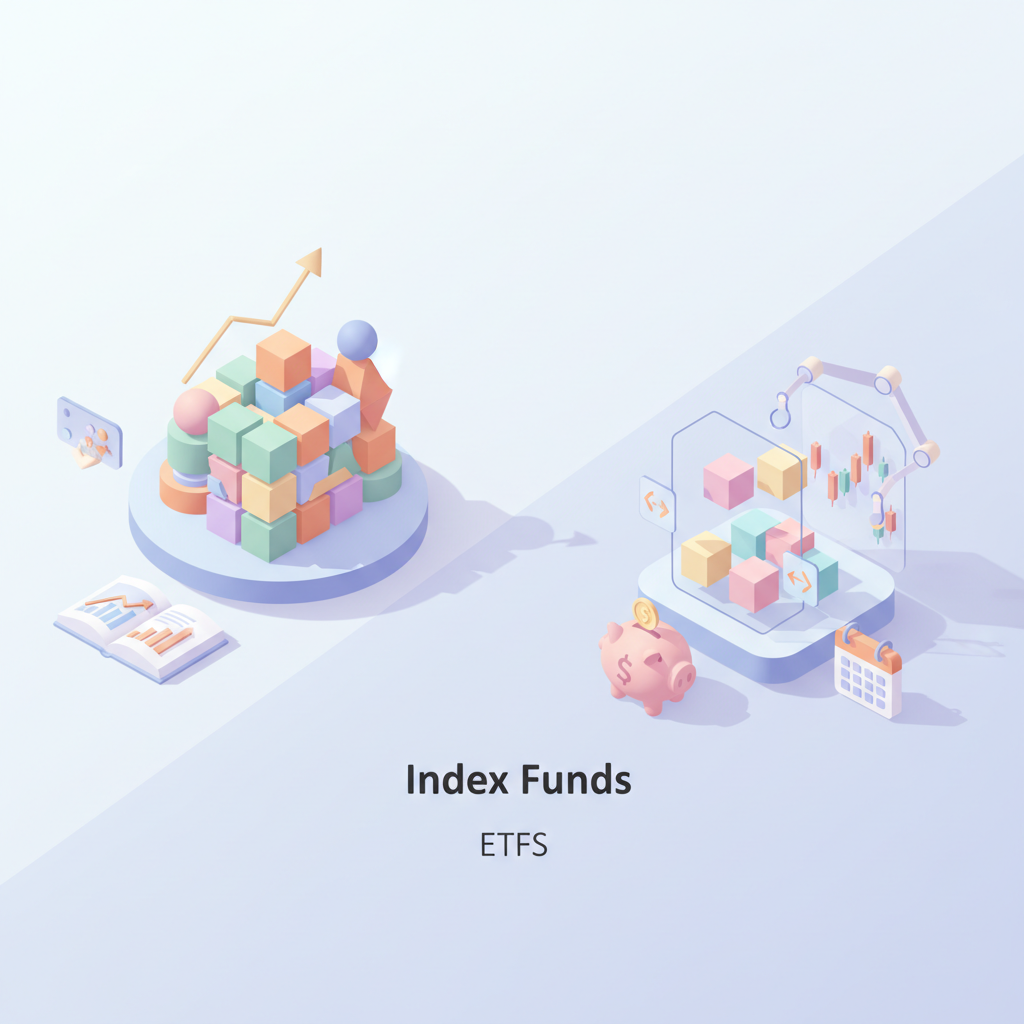
To understand Sarah’s dilemma, we first have to strip away the marketing. At their heart, both index funds and ETFs are types of 'baskets.' Instead of buying a single stock like Apple or Tesla, you buy a piece of a basket that holds hundreds or thousands of stocks. If they both track the same index, their performance will be nearly identical. However, the way you interact with these baskets is where the paths diverge.
An index fund is a type of mutual fund. When Sarah buys shares of an index fund, she is buying them directly from the fund company. The price she pays is the Net Asset Value (NAV), which is calculated only once per day after the market closes. If Sarah puts in an order at 10:00 AM on a Tuesday, her trade doesn’t actually execute until the market shuts down at 4:00 PM ET. This creates a psychological 'peace' for many; you aren't watching a ticker tape move every second.
Conversely, an ETF—or Exchange-Traded Fund—is exactly what it sounds like: a fund that trades on an exchange, just like a stock. Sarah can buy an ETF at 10:05 AM and sell it at 10:10 AM if she chooses. The price fluctuates throughout the day. For an investor focused on investing for the long haul, this intra-day liquidity might seem like a distraction, but it offers specific advantages for those who want precise control over their entry and exit prices.
Why Sarah Chose an ETF for Her Brokerage Account
As Sarah dug deeper into the 2026 tax environment, she noticed a significant difference in how these two vehicles handle capital gains. According to the IRS Publication 550, distributions from mutual funds are taxable events. Because of the way mutual funds are structured, if other investors in the fund sell their shares, the fund manager may have to sell underlying stocks to pay them out. This can trigger capital gains for every shareholder in the fund—even if Sarah herself didn't sell a single share.
ETFs usually avoid this through an 'in-kind' redemption process. Instead of selling stocks to pay out departing investors, the ETF issuer swaps the stocks for ETF shares in a way that doesn't trigger a taxable event for the remaining shareholders. For Sarah, who was using a standard taxable brokerage account, this made the ETF the clear winner. She didn't want a surprise tax bill at the end of the year just because other people were panic-selling during a market dip.
If you are currently choosing between different holding accounts, you might also be looking at choosing the best brokerage for beginners in 2026 to find a platform that supports fractional shares of ETFs, which has become a standard feature this year. This allows investors like Sarah to invest as little as $5 into an ETF, even if a single share costs $500.
"In 2026, the 'tax alpha' provided by ETFs remains the single greatest structural advantage for investors holding assets in taxable accounts rather than IRAs."
When Index Mutual Funds Take the Lead
While the ETF won for Sarah’s taxable account, her 401(k) and IRA presented a different story. In a tax-advantaged account like a Roth IRA, the tax efficiency of an ETF doesn't matter because you aren't taxed on yearly distributions. Here, Sarah found the 'automation' factor of index mutual funds to be superior.
Many mutual funds allow for 'automatic investment plans.' Sarah could set her account to pull $500 from her checking account every Friday and automatically buy shares of an S&P 500 index fund. Because these are bought directly from the fund company, there is no 'bid-ask spread' (the small difference between what a buyer pays and a seller receives). For someone practicing a how to build a three fund portfolio 2026 strategy, the ability to set it and forget it is invaluable.
Furthermore, some institutional-class index funds in 2026 have expense ratios as low as 0.00% or 0.015%. While ETFs are also cheap, the 'human' element of having a fund that automatically reinvests dividends without Sarah having to log in and click 'buy' manually every quarter offered a behavioral advantage. She knew she was less likely to 'tinker' with her strategy if the system did the work for her.
Costs and Fees: Peeling Back the Layers
By 2026, the 'fee war' between major asset managers like Vanguard, BlackRock, and Fidelity has mostly resulted in a race to the bottom. According to the Investment Company Fact Book, the average expense ratio for index equity funds has dropped significantly since the early 2010s. However, Sarah realized that the 'expense ratio' is only one part of the cost of ownership.
When trading ETFs, investors must be aware of the bid-ask spread. If a fund is 'thinly traded' (meaning not many people are buying or selling it), the spread could be 0.10% or higher. This effectively works like a hidden commission. For major funds tracking the S&P 500 or the Total Stock Market, this spread is usually negligible—often just a penny—but for niche sectors or international funds, it can add up.
Index mutual funds don't have a bid-ask spread, but they sometimes have 'purchase fees' or 'redemption fees' if you sell too quickly (often within 30 to 90 days). Sarah had to check the fine print to ensure she wasn't going to be penalized for rebalancing her portfolio too frequently.
The Role of Minimums and Accessibility
One hurdle Sarah faced early on was the minimum investment requirement. Traditionally, many high-quality index mutual funds required a $3,000 or even $10,000 initial investment. In 2026, many of these have been waived by major brokerages, but some 'Admiral' or institutional shares still hold these gates.
ETFs have always been the 'great equalizer' in this regard. Since they trade like stocks, the minimum investment is simply the price of one share—or even less if your broker supports fractional shares. This makes ETFs the preferred choice for those following a best index funds for beginners 2026 path with limited starting capital.
Sarah appreciated that she could start with just $100 in an ETF while she saved up the larger chunks required for some of the specialized mutual funds she was eyeing for her long-term retirement goals. This accessibility is a cornerstone of the 'democratization of finance' that has defined the early 2020s.
Market Impact and Stability in 2026
A common question Sarah had—and one many investors ask the Federal Reserve during town halls—is whether the massive shift toward passive indexing is making the markets less stable. When everyone buys the same index fund, the underlying stocks are bought regardless of their individual health.
However, for the individual consumer, this 'macro' concern rarely affects daily operations. Whether you hold an index fund or an ETF, you are subject to the same market volatility. If the S&P 500 drops 10%, both Sarah’s index fund and her ETF will drop roughly 10%. The difference is simply that the ETF investor can see that 10% drop happening in real-time at noon, while the index fund investor doesn't see the official 'damage' until their account updates in the evening.
Summary of Sarah's Strategy
After weeks of research, Sarah settled on a split strategy. For her taxable brokerage account, she chose ETFs. This protected her from the capital gains distributions that often plague mutual funds and gave her the flexibility to sell specific 'lots' of shares if she ever needed to practice tax-loss harvesting.
For her 401(k) and her Roth IRA, she chose traditional index mutual funds. The ability to automate her contributions down to the penny, combined with the lack of a bid-ask spread and the behavioral benefit of not seeing price fluctuations every minute, made it the perfect 'set it and forget it' vehicle for her retirement.
Sarah also realized that while she was focused on growth, she needed to keep her 'safe' money truly safe. She took a portion of her emergency fund and looked into are online savings accounts safe? to ensure her liquidity was protected by the FDIC while her index funds and ETFs did the heavy lifting of wealth creation.
Final Professional Insight for 2026 Investors
The choice between an index fund and an ETF is rarely a 'wrong' one; it is a choice of 'optimal' vs 'optimized.' Both will outperform the vast majority of active stock pickers over a 20-year horizon due to their low costs and broad diversification.
As we look through the rest of 2026, the focus for most consumers should remain on their savings rate and their asset allocation. Whether you use the 'mutual' ticker or the 'exchange' ticker, you are already ahead of the curve simply by choosing a low-cost index strategy.
Frequently asked questions
- It depends on the account type. In a taxable brokerage account, ETFs are generally better due to tax efficiency. In a 401(k) or IRA, index mutual funds are often preferred for their ease of automation and lack of trading spreads.
By understanding these nuances, you can build a portfolio that survives the volatility of 2026 and thrives in the decades to follow. Remember that the tools you use—whether index funds or ETFs—are just vehicles to get you to your financial destination. The most important part of the journey is staying in the car.
Related articles
See all →
Choosing the Best Brokerage for Beginners in 2026: A Complete Guide
Looking for the best brokerage for beginners to start your journey? Our 2026 guide compares top platforms based on fees, educational tools, and ease of use to help you invest.

Dollar Cost Averaging Explained: A Strategic Guide for 2026 Investors
Curious about dollar cost averaging explained? Learn how this consistent investment strategy helps manage market volatility and build wealth effectively in 2026.

Index Funds vs ETFs: How to Choose the Best Path in 2026
Wondering about index funds vs etfs for your portfolio? Discover the key differences in costs, tax efficiency, and trading rules for investors in 2026.

Index Funds vs ETFs: The 2026 Comparison Guide for Investors
Discover the key differences in index funds vs etfs to optimize your portfolio. Our 2026 guide covers costs, taxes, and liquidity for smarter long-term wealth building.