Savings Account vs Money Market Account: 2026 Comparison Guide
Wondering about a savings account vs money market account in 2026? Learn how interest rates, check-writing, and FDIC insurance differ to find the best place for your cash.
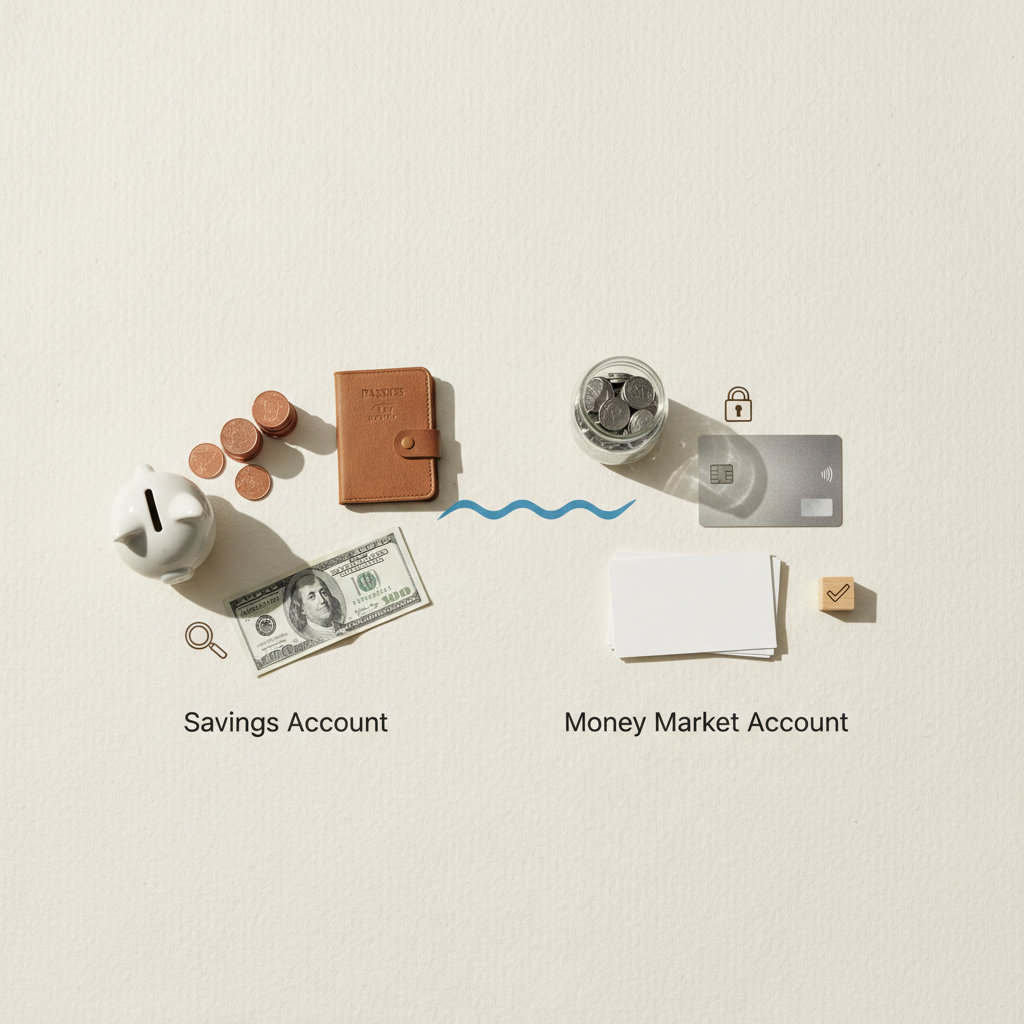
According to the latest FDIC National Rates and Rate Caps, the average national interest rate for savings accounts has hovered near 0.45% throughout the early months of 2026, while competitive online yields tell a vastly different story. For American consumers, the decision between a savings account vs money market account is no longer about pennies; it is about maximizing the purchasing power of every dollar in an era of persistent economic shifts. By the numbers, households that strategically move funds from standard brick-and-mortar accounts to high-yield vehicles are earning over 10 times the national average in annual interest.
Navigating these choices requires an analytical eye. While both accounts offer a safe harbor for your emergency fund, they serve distinct roles in a modern financial portfolio. Whether you are looking for the absolute highest yield or the convenience of check-writing, understanding the structural differences between these products is the first step toward financial optimization.
By the Numbers 2026
The Data-Driven Comparison: What the Numbers Actually Say
When comparing a savings account vs money market account, the decision often hinges on how you intend to access your money. A traditional high-yield savings account is built for accumulation, while a money market account (MMA) acts as a hybrid between savings and checking. To appreciate the differences in the current market, we must look at the feature sets side-by-side.
| Feature | High-Yield Savings | Money Market Account |
|---|---|---|
| Current Top APY Range | 4.30% - 4.65% | 4.40% - 4.75% |
| Check Writing | No | Yes (Limited) |
| Debit Card Access | Rare | Common |
| Min. Balance Requirement | Low ($0 - $100) | Moderate ($500 - $2,500) |
| Insurance Type | FDIC or NCUA | FDIC or NCUA |
| Ideal Use Case | Long-term Emergency Fund | Mid-term liquid reserves |
As the data suggests, MMAs often provide a slight edge in accessibility, typically including a debit card or check-writing capabilities. However, this convenience sometimes comes at the cost of higher minimum balance requirements. For those who prefer a "set it and forget it" approach, high-yield savings accounts remain the gold standard for pure growth without the temptation of easy spending.
The Interest Rate Landscape in 2026
Interest rates have stabilized following the Federal Reserve's policy shifts in late 2025. Today, savers are seeing a convergence in rates. According to the Federal Reserve H.15 report, commercial bank rates for money market accounts have remained competitive with online-only savings yields. This is a departure from previous years where savings accounts almost always led the pack.
If you are evaluating how to choose a high yield savings account in 2026 guide, you must look beyond the marquee rate. Many online banks now use tiered interest structures. An MMA might offer 4.75% but only for balances above $25,000, whereas a high-yield savings account might offer 4.55% on every dollar from the very first cent.
Understanding the Savings Account: A Foundation for Growth
A savings account is perhaps the most fundamental tool in the American banking system. It is a deposit account held at a retail bank that pays interest but cannot be used directly as money in the medium of exchange (for example, by writing a check).
Mechanics of Modern Savings In 2026, the primary benefit of a savings account is its simplicity. Most online institutions have eliminated monthly maintenance fees, allowing your interest to compound without erosion. If you are comparing this to other fixed-income instruments, you might ask, are CDs worth it right now?. Unlike a Certificate of Deposit (CD), a savings account offers liquidity, meaning you can withdraw your funds at any time without a significant penalty, though Federal Reserve Regulation D (which previously limited withdrawals to six per month) has been relaxed, though many banks still enforce their own limits.
Security and Protections One of the most common questions is are online savings accounts safe?. The answer remains a resounding yes, provided the institution is covered by the FDIC. The Federal Deposit Insurance Corporation (FDIC) provides up to $250,000 in protection per depositor, per insured bank, for each account ownership category. This makes a savings account one of the safest places to store your wealth compared to market-based investments.
Understanding the Money Market Account: The Hybrid Vehicle
Traditional money market accounts often get confused with money market funds. A money market fund is a type of mutual fund found at a brokerage, whereas a money market account is a bank deposit product insured by the FDIC.
The Convenience Factor What separates an MMA in the savings account vs money market account debate is the transactional flexibility. Many MMAs come with a set of checks and a Visa or Mastercard debit card. This allows you to pay a large contractor, a tax bill, or an emergency repair directly from your interest-bearing account. This eliminates the need to first transfer money to a checking account, which can sometimes take 1-3 business days if you are moving money between different banks.
The Cost of Entry While high-yield savings accounts often have $0 minimums, MMAs are frequently marketed toward "premier" or high-balance clients. It is not uncommon to see a $1,000 or $5,000 minimum deposit to waive a monthly fee. If your balance dips below this threshold, the fees can quickly outpace the interest earned. This is similar to the trade-offs found when choosing the best brokerage for beginners in 2026, where account minimums often dictate the level of service and features provided.
Transactional Differences: Liquidity vs. Convenience
While both accounts are considered liquid, there is a nuance to how that liquidity is accessed.
- Direct Spending: MMAs allow you to spend directly from the account. Savings accounts do not.
- Transfer Delays: Moving money from an online savings account to an external checking account can take time. If you use an MMA at the same bank where you maintain your checking, the transfer is usually instantaneous.
- ATM Access: Many MMAs provide ATM cards, allowing for cash withdrawals. While some savings accounts offer this, it is far less common in the high-yield online space.
For most consumers, the choice comes down to whether they want their emergency fund to be "out of sight, out of mind" or readily available for a large, sudden purchase. If you value a barrier to prevent impulsive spending, the savings account is superior.
What the Numbers Actually Say: Yield Analysis 2026
Let’s analyze a hypothetical $50,000 deposit over one year in the 2026 rate environment.
- Traditional Savings at a Big Bank (0.01%): $5.00 in annual interest.
- High-Yield Savings (4.50%): $2,250 in annual interest.
- Money Market Account (4.60%): $2,300 in annual interest.
The difference between a top-tier savings account and a top-tier MMA is often marginal—in this case, just $50. Therefore, the decision should be based on features rather than just interest rates. The Consumer Financial Protection Bureau (CFPB) emphasizes that consumers should compare the "hidden" costs of these accounts, such as paper statement fees or excess transaction fees, which can vary significantly between the two account types.
Factors to Consider When Choosing Between the Two
1. The Minimum Balance Barrier If you are just starting to build your emergency fund, a savings account is almost always the better choice. Many of the best savings accounts allow you to open an account with as little as $1. MMAs that offer the highest competitive rates often require a larger initial deposit. If you lock up $5,000 just to avoid a $15 monthly fee, but you only have $5,000 total, you have no margin for error.
2. Frequency of Use Do you plan to touch this money more than twice a year? If so, the MMA's check-writing ability is a significant perk. If the money is for a 20-year rainy-day fund, the extra features of an MMA are unnecessary fluff that may complicate your tax reporting or account management.
3. Tiered Interest Rates In 2026, many banks have moved to "relationship pricing." You might get a higher MMA rate if you also have a checking account with the same institution. This is a common tactic to increase "stickiness," as seen in the best checking accounts with sign up bonus 2026. Always read the fine print to see if the advertised rate requires a secondary account.
Strategic Placement: Where Does Each Fit?
To build a robust financial plan, you don't necessarily have to choose just one. Many financial advisors suggest a tiered approach to liquidity:
- Tier 1: Checking Account. 1-2 months of expenses for daily bills.
- Tier 2: Money Market Account. 2-3 months of expenses for mid-sized emergencies (car repairs, medical bills).
- Tier 3: High-Yield Savings Account. The remainder of your 6-12 month emergency fund, safely tucked away to earn maximum yield.
- Tier 4: Long-Term Growth. For funds not needed for 5+ years, investors might look into treasury bills vs CDs vs HYSA 2026 or even market-based investments.
The Role of Inflation in 2026
It is important to remember that while 4.5% to 4.7% sounds impressive, real returns are determined by inflation. According to the Bureau of Labor Statistics, if inflation is running at 3%, your real gain is only about 1.5%. This is why seeking out the highest possible yield in the savings account vs money market account battle is vital—you aren't just looking for extra cash; you are fighting to preserve your wealth's future value.
Frequently asked questions
- Both are equally safe if they are FDIC-insured at a bank or NCUA-insured at a credit union. Each offers up to $250,000 in protection per depositor.
Technical Realities: How the Bank Uses Your Money
To understand why these accounts exist, it helps to know what happens behind the scenes. Banks use the money you deposit in a savings account to fund long-term loans, like mortgages. Because these are long-term assets for the bank, they prefer you keep the money steady and inactive.
In contrast, Money Market Accounts were originally designed to allow banks to compete with money market mutual funds. The bank typically invests MMA deposits in short-term, highly liquid debt instruments, such as government securities and commercial paper. This is why the rates fluctuate so closely with the Federal Funds Rate. This also explains why MMAs can sometimes offer slightly higher rates when short-term credit markets are tight.
Final Verdict: Which One Should You Choose?
In the final analysis of the savings account vs money market account debate, the "winner" depends on your logistical needs.
- Choose a Savings Account if: You want the highest possible rate on a small-to-medium balance, you don't need to spend the money directly, and you want $0 fees.
- Choose a Money Market Account if: You maintain a high balance (over $5,000), you want the ability to write a check in an emergency without waiting for a transfer, and you prefer having a debit card for your savings.
As we progress through 2026, the gap between these two products continues to narrow. The most important action is not finding the perfect account, but moving your money out of low-interest checking accounts and into a vehicle that respects the value of your labor through competitive compounding.
Related articles
See all →
Are Online Savings Accounts Safe? Protection and Security Guide 2026
Wondering are online savings accounts safe? Explore FDIC protections, cybersecurity protocols, and how to protect your cash in our comprehensive 2026 guide for savers.

Maximize Your Cash: How to Choose a High Yield Savings Account in 2026
Learn how to choose a high yield savings account in 2026 by comparing APYs, safety, and digital features. Our expert guide helps you optimize your cash strategy today.

Choosing the Best Savings Account for Kids: A 2026 Parent's Guide
Discover how to find the best savings account for kids in 2026. This case study helps parents compare youth banking features, high rates, and educational apps to build wealth.

How Savings Account Interest Is Calculated: A 2026 Math Guide
Master the formulas behind your bank balance. Learn exactly how savings account interest is calculated in 2026 to maximize your APY and compound earnings.