Savings Account Minimum Balance Requirements Explained for 2026
Learn how to avoid fees and optimize interest with our savings account minimum balance requirements explained guide, featuring 2026 data on thresholds and banking costs.
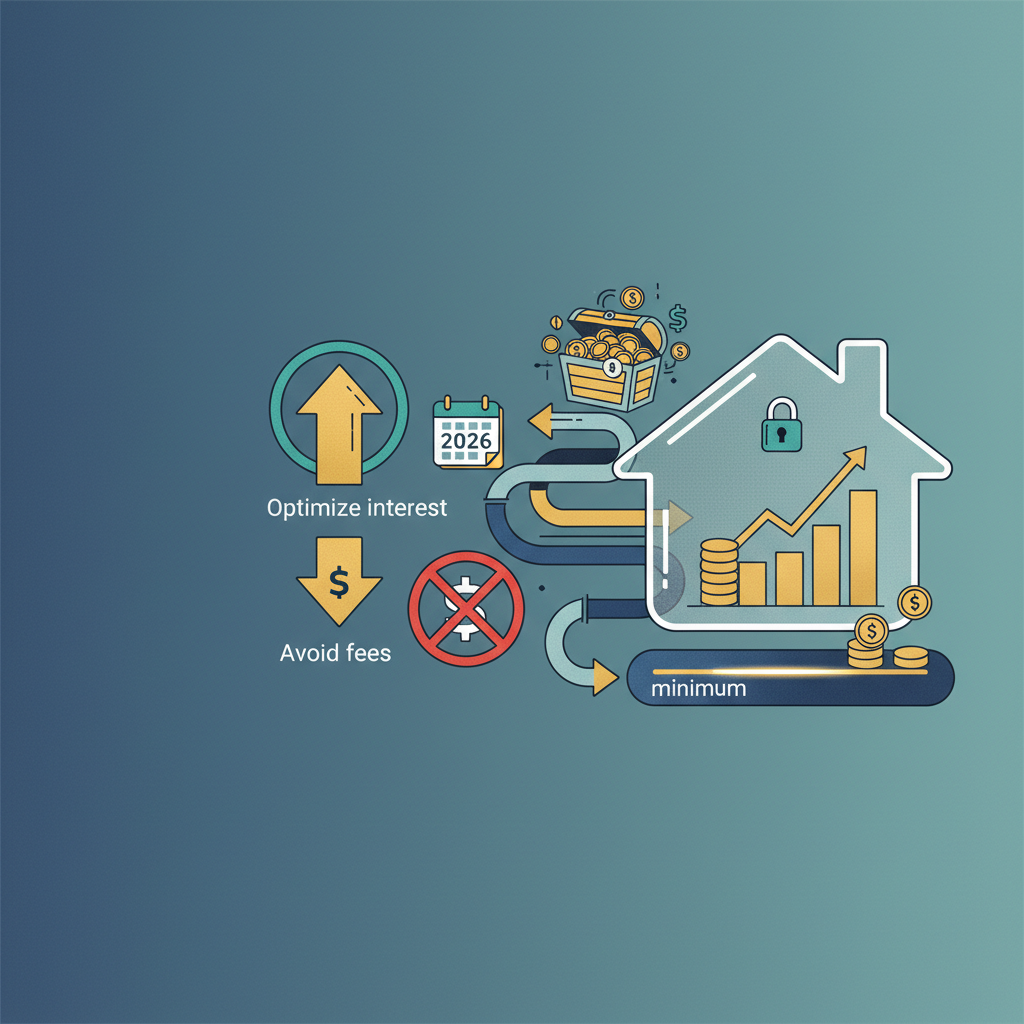
Understanding exactly how much cash you need to keep in your bank is a fundamental part of financial health. Whether you are opening your first account or managing a complex portfolio, having savings account minimum balance requirements explained can save you hundreds of dollars in unnecessary fees. In 2026, as interest rates fluctuate and digital banks compete for your deposits, the traditional 'minimum' has evolved into a multi-tiered system of requirements that vary wildly between institutions.
What are savings account minimum balance requirements?
At its core, a minimum balance requirement is a threshold set by a financial institution that dictates how much money must be in your account to avoid a monthly maintenance fee or to earn the advertised Annual Percentage Yield (APY). These requirements are generally split into two categories: the minimum to open the account and the minimum to maintain it without penalty. According to the FDIC's National Rates and Rate Caps, national averages for savings rates often hover around 0.45%, but achieving the best possible returns frequently requires meeting specific balance tiers.
When you look at high-yield savings accounts, you will find that online-only banks often have $0 minimum balance requirements to maintain the account, whereas traditional brick-and-mortar storefronts may require $300 to $5,000 to waive fees. Understanding these nuances is the first step toward keeping more of your own money.
Why do banks have these requirements in 2026?
Banks are businesses that profit by lending out the money you deposit. If an account has a very low balance, the cost for the bank to maintain that account—through customer service, digital infrastructure, and regulatory reporting—might exceed the profit they can make from those funds. To offset this, they impose fees. However, by 2026, we have seen a significant shift toward 'fee-free' banking models, especially within the fintech sector. If you are struggling with a restrictive bank, you might want to consult A Complete How to Switch Banks Checklist for 2026 to find a provider that aligns better with your current cash flow.
What is the difference between an opening deposit and a maintenance balance?
A 'minimum opening deposit' is the lump sum required to physically establish the account. This could be as little as $1 at an online credit union or as much as $10,000 for a private wealth management account. Once the account is open, the 'minimum maintenance balance' takes over. This is the amount you must keep in the account on an ongoing basis to avoid a monthly fee. For many, these numbers are different. For example, a bank might require $100 to open the account but $500 to waive the $5 monthly maintenance fee.
Understanding Savings Account Minimum Balance Requirements Explained: Daily vs. Average?
This is where many consumers get caught off guard. Banks typically calculate your balance in one of two ways: 'Minimum Daily Balance' or 'Average Monthly Balance.'
- Minimum Daily Balance: If your balance drops below the required threshold for even one second during the billing cycle, you are charged the fee. Even if you have $10,000 for 29 days, but on day 30 you have $4.99 (when the requirement is $5.00), you will pay the fee.
- Average Monthly Balance: This is more forgiving. The bank adds up your balance at the end of every day in the cycle and divides it by the number of days. If the resulting average is above the requirement, you are safe.
Before committing to a new provider, especially when looking for the best credit union savings rates for 2026, always read the Schumer Box or the account agreement to see which calculation method they use.
How do these requirements affect your interest earnings?
In many cases, a bank will allow you to maintain an account with a very low balance, but you won't earn any interest. This is known as the 'minimum balance to earn APY.' In the current 2026 rate environment, it is common to see 'tiered' interest rates. For instance, you might earn 4.00% on the first $25,000 and 0.50% on everything above that. Conversely, some accounts don't pay any interest at all unless you maintain at least $1,000.
If you find that your current balance is too low to earn meaningful interest, you may want to compare your options. In 2026, some consumers are looking toward other vehicles for their cash. To see how these accounts stack up against government-backed securities, read HYSA vs Treasury Bills: Where Should You Park Your Cash in 2026? to ensure you are maximizing every dollar.
Can you avoid minimum balance fees without keeping the money in the account?
Yes. Many banks offer several 'escape hatches' to waive monthly fees even if your balance is low: - Linked Accounts: Often, if you link a savings account to a premium checking account at the same bank, the requirements are waived. - Direct Deposit: High-frequency direct deposits (like a paycheck) can sometimes override the balance requirement. This is a strategy often used in the checking world as well, as detailed in Mastering Checking Account Direct Deposit Requirements in 2026. - Age-Based Waivers: Many banks waive all minimums for students under 24 or seniors over 65. - Direct Relationship: Maintaining a mortgage or auto loan with the same institution often grants you 'preferred' status, eliminating maintenance fees.
How do 2026 savings account rates and requirements compare?
As of June 2026, the market is bifurcated. Large national banks still command the majority of deposits despite higher minimums, while online challengers offer lower entry barriers. Use the table below to see how these requirements generally scale based on the type of institution.
| Bank Type | Typical Min. to Open | Min. to Waive Fee | Monthly Maint. Fee | Est. APY |
|---|---|---|---|---|
| National Mega-Bank | $25 - $100 | $300 - $500 | $5 - $15 | 0.01% - 0.05% |
| Elite Online HYSA | $0 | $0 | $0 | 4.25% - 5.10% |
| Local Credit Union | $5 - $25 | $0 - $100 | $0 - $5 | 0.50% - 3.00% |
| Neo-Bank / Fintech | $0 | $0 | $0 | 3.50% - 4.50% |
What happens if you fall below the minimum balance?
If you drop below the threshold, the bank will typically assess a 'Monthly Maintenance Fee' at the end of your statement cycle. In 2026, these fees typically range from $5 to $25 per month. While that might seem small, a $15 monthly fee on a $200 balance represents a 90% annual negative return. It effectively 'eats' your savings. According to the Consumer Financial Protection Bureau (CFPB), banking fees remain a significant burden for lower-income households, which is why choosing an account with $0 requirements is often the smartest move for an emergency fund.
Does the Federal Reserve influence these requirements?
The Federal Reserve System does not set specific minimum balance levels for banks; those are private business decisions. However, the Fed's monetary policy influences how much banks want your money. When the Fed raises interest rates, banks are more eager to attract deposits to fund their lending activities, which can lead to lower minimum balance requirements or promotional offers. In 2026's stabilized rate environment, banks are more focused on 'sticky' deposits—meaning they want customers who keep their money in place for long periods.
Are there accounts with absolutely no minimum balance requirements?
Absolutely. The rise of digital banking has revolutionized this space. Most high-yield savings accounts offered by online leaders have eliminated these barriers entirely. They do not charge monthly fees regardless of your balance and do not require a specific amount to earn interest. This makes them ideal for people just starting their savings journey or for those who need a place to store smaller amounts of money without it being eroded by fees.
How should you choose a requirement level that fits your life?
Choosing an account is a balance between convenience and cost. If you value having a physical branch you can walk into, you may have to accept a $300 to $500 minimum balance requirement. If you are comfortable managing your money entirely via an app, you can easily find accounts with no requirements at all. Always evaluate your 'buffer.' If you know your emergency fund will never dip below $1,000, then a bank with a $500 minimum requirement is perfectly safe for you. If your income is irregular, you should prioritize accounts with no maintenance fees whatsoever.
Important terminology you will see in 2026 bank disclosures
To make an informed decision, you must speak the bank's language. Here are three terms that are frequently used in the context of minimum balances: - Combined Balance: Some banks let you avoid a fee on your savings account if the sum of your checking, savings, and CD balances stays above a certain level (e.g., $5,000 total across all accounts). - Tiered Yield: An account structure where the interest rate changes based on how much money is in the account. - Grace Period: Some banks will give you 30 to 60 days after opening an account to reach the minimum balance before they start charging the monthly fee.
Common Pitfalls: The 'Hidden' Minimums
Sometimes, a bank will advertise 'No Minimum Balance,' but there is a catch. For instance, the account might be free, but if it stays at a $0 balance for more than 60 days, the bank might automatically close it. In other cases, you might need a minimum balance to even see your account's 'High Yield' status. Always ensure you are looking for the 'Minimum Balance to Earn APY' specifically.
Additionally, be wary of 'Activity Requirements.' Some accounts are only free if you make a certain number of debit card transactions or log into the mobile app once a month. While not technically a 'balance' requirement, it creates a similar hurdle for staying fee-free.
Summary of Strategy for 2026
In the current financial climate, there is no reason to pay a fee just to store your money. With the abundance of online options, including those explored in Best Savings Accounts for Kids 2026: 7 Myths vs Reality, consumers have more leverage than ever. If your bank is charging you for a low balance, it is a sign that they do not value your business as much as a competitor would. By 2026 standards, a good savings account should offer both a competitive yield and a fee-free experience regardless of whether you have $5 or $50,000 in the account.
Always remember that your savings account is there to provide security. If the requirements for that account create stress or a financial drain, that account is not doing its job. Take the time to audit your monthly statements. If you see 'Service Charge' or 'Monthly Maintenance Fee,' it is time to shop around.
Frequently asked questions
- Most online-only high-yield savings accounts currently have a $0 minimum balance requirement to open and earn interest. Local banks may still require $300 to $500 to waive fees.
Related articles
See all →
Best Savings Accounts for Kids 2026: 7 Myths vs Reality
Discover the best savings accounts for kids 2026 based on data, not hearsay. We debunk common myths about yields, fees, and age limits for young savers.

Joint Savings Account Pros and Cons: A 2026 Guide for Shared Wealth
Is sharing a bank account right for you? Explore the essential joint savings account pros and cons in 2026 to manage shared financial goals with confidence.

Mastering High Yield Savings Withdrawal Limits in 2026
Learn how high yield savings withdrawal limits work in 2026, including Regulation D updates, excess transaction fees, and tips to maintain liquidity while maximizing APY.

Savings Account Interest Calculator How It Works: A 2026 Guide
Discover the math behind your wealth with our guide on a savings account interest calculator how it works, covering compound frequency, APY, and 2026 bank rates.