
CD vs Savings Account for Emergency Fund: 2026 Myths Debunked
Should you choose a cd vs savings account for emergency fund safety? We debunk 6 common myths and compare the best liquidity strategies for your 2026 cash reserves.
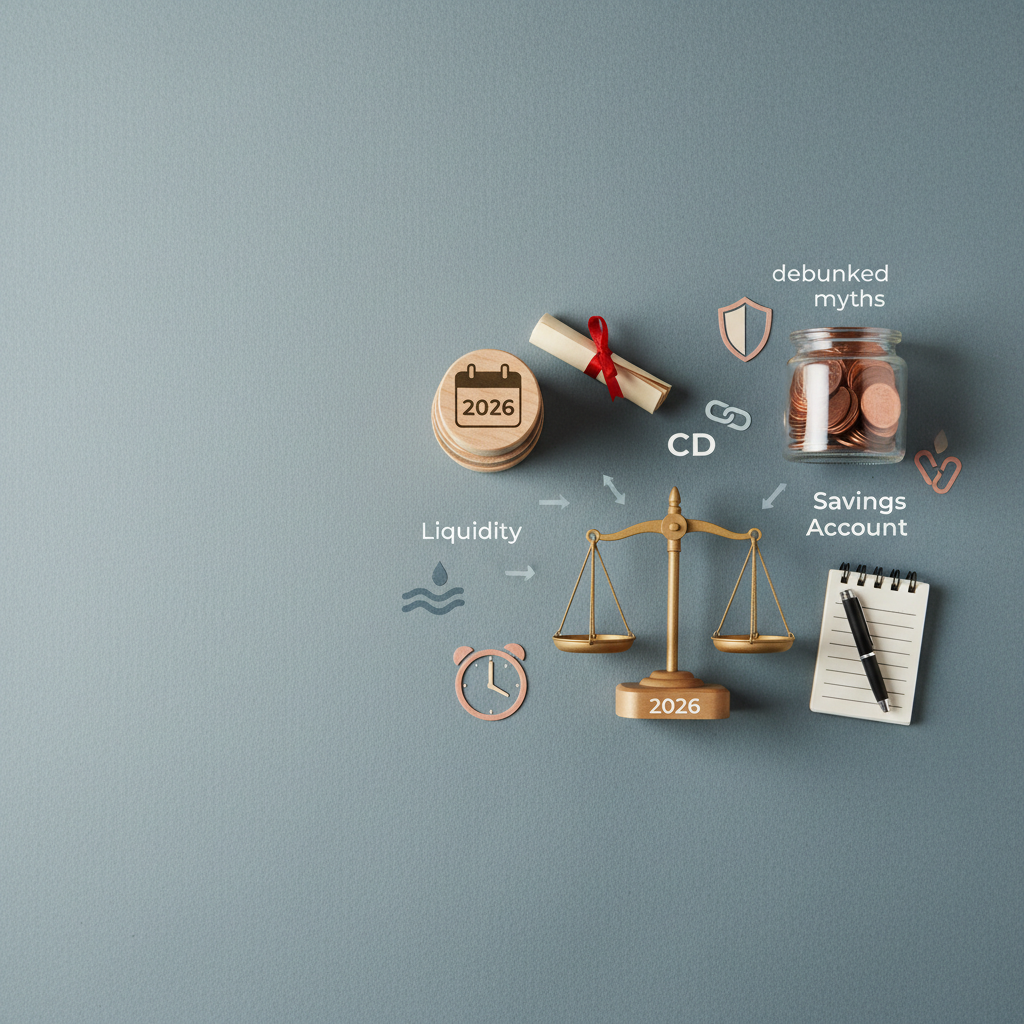
Deciding between a cd vs savings account for emergency fund placement is one of the most critical financial decisions you will face in 2026. While both accounts offer the security of federal insurance, they serve wildly different operational roles in a crisis. The goal of an emergency fund is simple: to provide immediate, friction-free access to cash when life goes sideways. Yet, as interest rates fluctuate following the Federal Reserve's recent policy shifts, many consumers are tempted to lock away their rainy-day cash in Certificates of Deposit (CDs) to capture higher yields.
Before you commit your safety net to a fixed term, you must understand the trade-offs between yield and accessibility. In this guide, we will analyze the various ways these two heavyweights stack up, debunking the most common myths that leave savers stranded during financial storms. Whether you are looking at different types of CDs for the first time or simply trying to optimize your current emergency fund where to keep it 2026 plan, the data shows that a hybrid approach is often the smartest play.
By the Numbers
Myth 1: CDs Are Always Better for Growth Than Savings Accounts
Many consumers believe that because a CD requires you to lock up your money, the bank will always pay a significantly higher rate than a standard high-yield savings account (HYSA). While this is historically true in a stable or rising rate environment, it is not a universal law of banking. In 2026, the gap between the most competitive HYSAs and short-term CDs has narrowed considerably.
According to the FDIC's National Rates and Rate Caps, the national average for a standard savings account remains low, but the top-tier online banks are offering yields that rival 6-month and 12-month CDs. If you are comparing a cd vs savings account for emergency fund growth, you might find that the extra 0.25% APY offered by a CD isn't worth the loss of liquidity.
Furthermore, if rates are trending upward, a savings account allows you to capture those increases immediately. Conversely, if you are worried about rates falling, are CD rates going up or down 2026? provides the context you need to decide if locking in a rate today is the better long-term hedge.
Myth 2: You Can't Touch CD Money in an Emergency
One of the most pervasive myths when discussing a cd vs savings account for emergency fund safety is that CD funds are "frozen." This is incorrect. You can almost always access your money in a CD before the maturity date; it simply comes at a price. This price is known as the early withdrawal penalty.
Typically, a bank will charge you a set amount of interest—often 90 days of earnings for a 12-month CD or up to 180 days for longer terms. In a true emergency, such as a major medical bill or job loss, the ability to pay a small penalty to access your principal is a viable, if suboptimal, exit strategy.
For those who want the best of both worlds, a "No-Penalty CD" is an increasingly popular option in 2026. These allow you to break the term without any fee, though they usually offer slightly lower rates than traditional CDs. If you are worried about how much money should I keep in savings? for immediate needs, keeping a portion in a liquid HYSA while the rest sits in a no-penalty CD can maximize your yield.
Myth 3: High-Yield Savings Accounts Don't Have Limits
When people choose a savings account over a CD for their emergency fund, they often assume they have 100% freedom. However, banking regulations and individual bank policies still exist. While the Federal Reserve's "Regulation D" (which previously limited savings withdrawals to six per month) has been suspended indefinitely, many banks still enforce their own transaction limits or charge fees for excessive withdrawals.
If your emergency fund is also your "oops" fund for monthly overages, you might find yourself hitting these walls. This is why many financial experts suggest looking at the best online savings accounts no-fees to ensure that the liquidity you think you have isn't eaten up by administrative costs.
Myth 4: Taxes on CD Interest and Savings Interest Are Differently Structured
There is a common misconception that one vehicle is more tax-efficient than the other. In reality, both CDs and savings accounts are taxed as ordinary income at the federal and state levels. The bank will issue a Form 1099-INT at the end of the year if you earn more than $10 in interest.
One nuance often missed is the timing of when taxes are due. For a savings account, you pay taxes on the interest credited to your account each month. For a CD, you are generally taxed on the interest as it is credited to the account, even if you haven't withdrawn the funds. This is a vital distinction for those with large balances. You can learn more about this in our tax efficiency guide 2026, which breaks down the specifics of state and federal obligations.
Myth 5: A CD Ladder is Too Complex for an Emergency Fund
A CD ladder involves splitting your emergency fund into several smaller CDs with staggered maturity dates (e.g., a 3-month, 6-month, 9-month, and 12-month CD). Many avoid this, thinking it requires constant management. However, in the modern 2026 banking era, most of this can be automated.
As each small CD matures, it rolls over into a new 12-month CD. This ensures that a portion of your emergency fund becomes available every few months without penalty.
Using a ladder effectively bridges the gap in the cd vs savings account for emergency fund debate. It provides the higher fixed rates of various CD terms while maintaining a regular cadence of liquidity.
Myth 6: FDIC Insurance Works Differently Depending on the Account
Some consumers worry that their money is "safer" in a CD because it has a contract, or "safer" in a savings account because it is more common. The reality is that both are covered by the same federal protections. The Federal Deposit Insurance Corporation (FDIC) provides up to $250,000 in coverage per depositor, per insured bank, for each account ownership category.
According to the FDIC's guide on Deposit Insurance, both CDs and savings accounts fall under the same category of protections. As long as your bank is FDIC-member (or NCUA-member for credit unions), your principal is protected up to the legal limits regardless of the account type.
Detailed Comparison: CD vs. Savings Account for Emergency Fund
To help you decide where to park your cash in 2026, we have summarized the primary differences below. Note how each factor affects your ability to react to a sudden financial shock.
| Feature | High-Yield Savings | Certificate of Deposit (CD) | Winner for Emergencies |
|---|---|---|---|
| Immediate Access | Instant (via transfer/ATM) | 1-5 Days (plus penalty) | Savings Account |
| Interest Rate | Variable (shifts with Fed) | Fixed (locked for term) | CD (in falling rates) |
| Minimum Deposit | Usually $0 - $100 | Often $500 - $2,500 | Savings Account |
| Risk of Loss | None (FDIC Insured) | None (FDIC Insured) | Tie |
| Fee Potential | Excess withdrawal fees | Early withdrawal penalties | Savings Account |
| Best Use Case | Immediate repairs/bills | Multi-month job loss fund | Hybrid Approach |
Why the "Tiered" Emergency Fund is the Real Solution
Rather than choosing one over the other, many financial planners in 2026 recommend at least two tiers for your cash reserves. This strategy acknowledges that not every "emergency" requires thousands of dollars at once.
Tier 1: The Immediate Liquidity Layer (Savings) This tier should consist of roughly one month of essential expenses. It should live in a high-yield savings account or even a money market account. The goal here isn't the highest APY—it's the ability to pay a mechanic or a plumber today. If you are debating among cash vehicles, our guide on high yield savings vs money market accounts can help you decide which provides the best transactional flexibility.
Tier 2: The Core Reserve Layer (CDs) Once you have your first month covered, the remainder of your 3-to-6-month emergency fund can be placed into CDs or a CD ladder. This allows you to earn a higher yield on the bulk of your money. Since most major emergencies (like job loss) play out over several months, the 30-to-90-day wait for a CD to mature—or the calculated decision to pay a penalty—is an acceptable risk for the higher return.
For those with substantial wealth, looking at the best jumbo CD rates 100k+ can significantly boost the passive income generated by your idle cash reserves.
Key Factors to Consider Before You Choose
When evaluating a cd vs savings account for emergency fund placement today, ask yourself the following four questions:
- How stable is my income? If you are a freelancer or business owner with volatile income, higher liquidity (savings) is more important than yield.
- What is the current Fed outlook? According to the Federal Reserve’s Monetary Policy reports, inflation and employment data dictate interest rate shifts. If rates are expected to fall, locking in a 12-month CD now is a wise move.
- What are the specific penalty terms? Not all CD penalties are created equal. Some banks only charge 1 month of interest, while others might take 6 months. Always read the fine print before opening the account.
- Do I have other credit available? If you have a credit card with a high limit or a HELOC, you might be more comfortable keeping your emergency fund in a CD, knowing you can use credit for 48 hours while you wait for a CD withdrawal to process.
Final Verdict for 2026
The choice between a cd vs savings account for emergency fund safety doesn't have to be an all-or-nothing proposition. In 2026, the most resilient consumers are those who use the strengths of both accounts. Use the savings account for the unpredictable, small-scale emergencies of daily life, and use the CD for the "catastrophic" insurance fund that you hope you never touch.
By debunking the myths of total illiquidity and perceived safety differences, you can stop leaving money on the table and start making your emergency fund work just as hard as you do.
Frequently asked questions
- For most people, a high-yield savings account is better for the first $2,000 to $5,000 of an emergency fund due to instant access. Funds beyond that can be moved into CDs to capture higher fixed rates.
Related articles
See all →
Tax Efficiency Guide 2026: Understanding How Are CDs Taxed State and Federal
Wondering how are CDs taxed in 2026? Learn about federal interest income rules, state taxes, and 1099-INT requirements to keep more of your earnings this year.

Securing No Penalty CD Best Rates 2026: Top Liquid Yields Compared
Looking for the no penalty cd best rates 2026? Compare top yields, understand early withdrawal flexibilty, and lock in high interest without the long-term commitment.

No Penalty CD Best Rates 2026: Lock in Yields Without the Risk
Discover the no penalty cd best rates 2026 to maximize your interest while maintaining full liquidity. Compare top bank offers and secure your financial future today.
Best Jumbo CD Rates 100k+: Compare Top Yields for May 2026
Looking for jumbo cd rates 100k or more? Compare the highest-yielding 100,000 certificate of deposit options in 2026 to lock in guaranteed returns for your cash reserves.