
CD Ladder vs Bond Ladder: Which Is Better for Your Income in 2026?
Wondering about a cd ladder vs bond ladder which is better for your savings? Compare rates, risks, and liquidity in our comprehensive guide for 2026 investors.
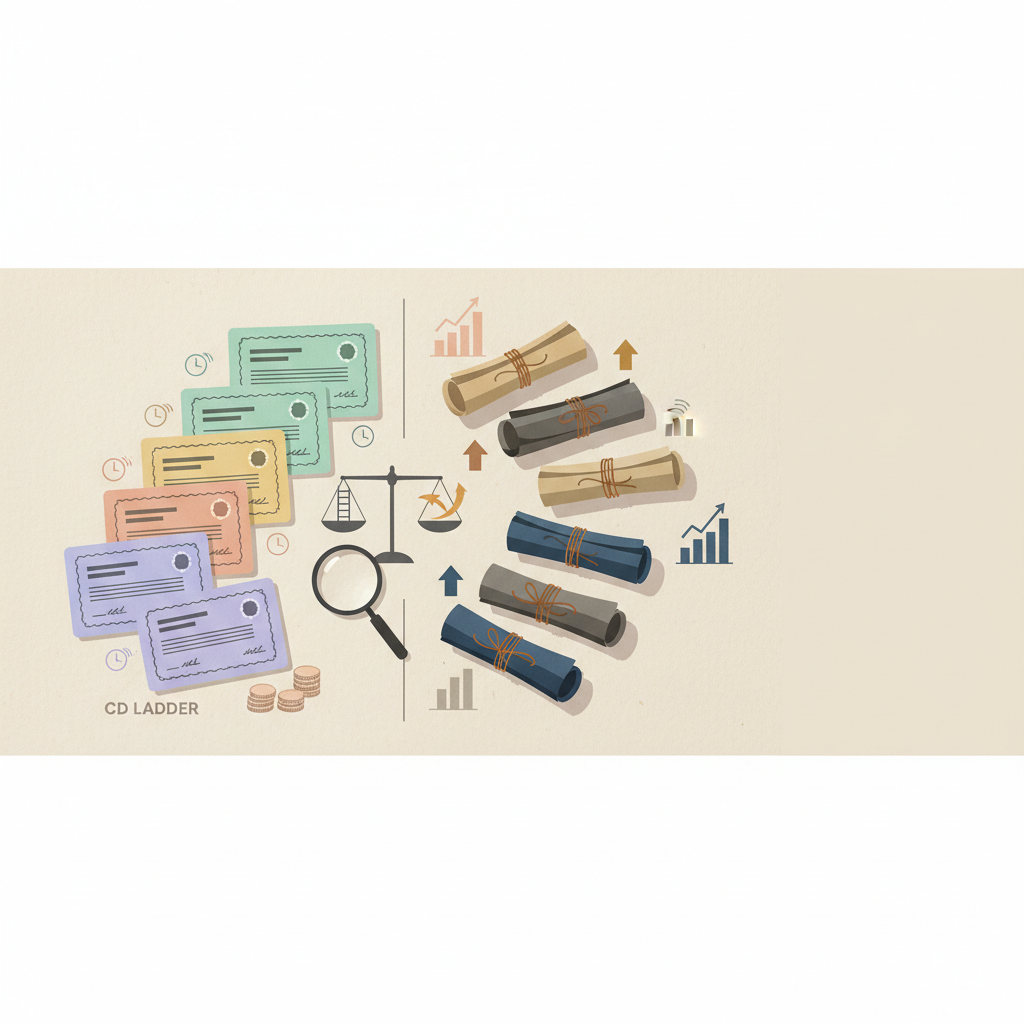
Deciding between a cd ladder vs bond ladder which is better for your specific financial profile requires more than a cursory glance at current yields. As we navigate the middle of 2026, the fixed-income landscape remains a cornerstone for conservative investors looking to mitigate interest rate risk while maintaining a steady flow of cash. Both strategies involve staggering maturity dates—spacing out your investments so that a portion of your principal becomes available at regular intervals—but they rely on fundamentally different financial instruments with unique tax implications and risk profiles.
In the current economic environment, the Federal Reserve has signaled a stabilizing posture following the volatility of the mid-2020s. This stability makes laddering particularly attractive. By not locking all your capital into a single maturity date, you protect yourself against the 'opportunity cost' of rising rates and the 'reinvestment risk' of falling rates. But when you stack them up, the choice between Certificates of Deposit (CDs) and Bonds depends on whether you value the government-backed simplicity of a bank or the potentially higher, tax-advantaged yields of the open market.
| Feature | CD Ladder | Bond Ladder (Treasury/Muni) | Bond Ladder (Corporate) |
|---|---|---|---|
| Principal Protection | FDIC/NCUA Insured ($250k) | Full Faith & Credit / Market Risk | Market Risk / Credit Risk |
| Tax Treatment | Fully Taxable (Interest) | Treasury: State/Local Exempt | Fully Taxable |
| Liquidity | Penalty for Early Withdrawal | Marketable (Price Fluctuations) | Marketable (Spread Risk) |
| Default Risk | Zero (up to limits) | Near Zero / Moderate | Low to High |
| Typical Yield (2026) | 4.25% - 4.85% | 4.10% - 5.10% | 5.25% - 6.50% |
The CD Ladder: Simplicity and Safety via FDIC Insurance
A CD ladder is perhaps the most beginner-friendly fixed-income strategy. In 2026, many investors are returning to this method because it removes the guesswork of market price fluctuations. When you buy a CD from a bank or credit union, you are effectively providing a loan to that institution for a set period. In return, the bank pays you a fixed interest rate.
The mechanics are straightforward. If you have $50,000, you might put $10,000 each into a 1-year, 2-year, 3-year, 4-year, and 5-year CD. When the 1-year CD matures in 2027, you reinvest those funds into a new 5-year CD. This creates a perpetual cycle of maturing cash. This setup is highly effective for an emergency fund that you don't expect to touch. However, for those who need more immediate access to cash without breaking a ladder, it's worth choosing the best high yield savings account for emergency fund 2026 guide as a liquid buffer.
According to the FDIC National Rates and Rate Caps, the average yield on a 12-month CD has remained competitive with shorter-term Treasuries throughout the first half of 2026. The primary benefit here is the lack of price risk. Unlike a bond, your CD balance doesn't drop if interest rates rise; the only 'loss' you face is the opportunity to earn a higher rate elsewhere.
If you find that CD rates are dipping, you might also compare these returns against other conservative options. For instance, understanding how much should I keep in a high yield savings account in 2026 can help you decide how much to lock away in a ladder versus keeping in a liquid, variable-rate account.
CD Laddering — Pros & Cons 2026
- Guaranteed principal via FDIC or NCUA insurance up to $250,000 per institution.
- Fixed interest rates provide predictable cash flow and protection from falling rates.
- Extremely easy to set up through any online or local bank.
- Early withdrawal penalties can be substantial, often 3-12 months of interest.
- Fully taxable at both federal and state levels, which can drag on real returns.
- Inflation risk: if inflation exceeds the APY, you lose purchasing power.
The Bond Ladder: Market Flexibility and Tax Advantages
When we ask "cd ladder vs bond ladder which is better," the bond ladder often wins for investors in higher tax brackets or those with larger portfolios. A bond ladder typically utilizes U.S. Treasury securities, municipal bonds, or corporate bonds.
The core difference is that bonds are tradable securities. If you buy a 5-year Treasury note as part of your ladder, you can sell it on the secondary market before it matures. While this provides liquidity, it introduces market risk. If interest rates have risen since you bought the bond, the market price of your bond will fall. Conversely, if rates have fallen, your bond becomes more valuable. This dynamic can be explored further in our savings account interest rates forecast 2026, which looks at the broader interest rate environment influencing these prices.
For most individual investors, Treasuries are the gold standard for bond ladders. As noted by the U.S. Department of the Treasury, these are backed by the full faith and credit of the U.S. government. A major advantage of Treasuries is that the interest is exempt from state and local income taxes—a significant perk if you live in high-tax states like New York or California.
Municipal bonds take this a step further, often offering interest that is exempt from federal taxes as well. For a wealthy investor, a "tax-equivalent yield" on a muni bond might far exceed what a bank CD can offer. However, bonds usually require a higher minimum investment (often $1,000 increments) and may involve brokerage fees or "spreads" that eat into your yield.
Bond Laddering — Pros & Cons 2026
- Enhanced liquidity: You can sell bonds on the secondary market at any time.
- Tax efficiency: Treasuries are state/local tax-exempt; Munis can be federally tax-exempt.
- Potential for capital gains if interest rates drop during the holding period.
- Market risk: The value of your bonds will fluctuate daily until maturity.
- Complexity: Requires a brokerage account and a deeper understanding of yield-to-maturity.
- Credit risk: Corporate or municipal issuers could theoretically default, unlike FDIC-insured banks.
CD Ladder vs Bond Ladder Which Is Better? Key Comparison Points
To truly determine which is better, you must assess several factors including your tax bracket, your need for liquidity, and your tolerance for seeing your account balance fluctuate.
1. The Safety Factor CDs offer the ultimate peace of mind. As long as you stay within the FDIC insurance limits, your principal is safe even if the bank fails. This makes CDs the preferred choice for those who are in or very near retirement and cannot afford any loss of nominal principal. While U.S. Treasuries are also considered risk-free if held to maturity, the daily price fluctuations in a brokerage account can be unnerving for a conservative saver.
2. Tax Efficiency This is where the "better" choice shifts toward bonds for many. CD interest is taxed as ordinary income. If you are in the 32% tax bracket, a 5.00% CD only nets you 3.4% after federal taxes. A Treasury bond paying 4.5% might actually leave you with more money in your pocket because of the state tax exemption. If you are comparing these products to other fixed-rate instruments, you may also want to look at the best fixed annuity rates in 2026, which can offer tax-deferred growth—another way to shield your earnings from the IRS.
3. Ease of Management Managing a CD ladder is relatively "set it and forget it." Most online banks offer automatic rollover features. Bond ladders require more active management. You need to monitor maturity dates and manually purchase new bonds through a brokerage like Schwab, Fidelity, or Vanguard. For some, this complexity is a barrier; for others, the control over specific coupon rates and maturity dates is an advantage.
Strategic Use of Each Ladder in 2026
As we look at the current economic cycle, a "hybrid" approach is gaining popularity among savvy savers. This involves using a CD ladder for short-term needs (1-3 years) and a bond ladder for longer-term income (5-10 years).
In early 2026, yield curves have shown a slight normalization, meaning longer-term rates are finally providing a premium over shorter-term rates. This makes building a 5-year ladder more rewarding than it was in the early 2020s. If you are considering a ladder specifically for retirement, you might also weigh these against insurance products. For instance, a fixed indexed annuity vs. CD comparison might show that annuities offer better long-term protection against living too long, whereas a ladder offers better access to your heirs.
Implementation Steps for American Savers
Regardless of which you choose, the process for building your ladder in 2026 follows a standard path:
- Determine your total allocation: How much of your portfolio belongs in fixed income? Research by groups like the Federal Reserve Board suggests that maintaining a ladder can significantly reduce the volatility of a total portfolio.
- Select your 'rungs': Most investors choose annual rungs (1, 2, 3, 4, 5 years). High-frequency savers might even do monthly rungs (3, 6, 9, 12 months).
- Choose your platform: For a CD ladder, look for online banks with the highest APYs. For a bond ladder, ensure your brokerage offers a 'ladder tool' to automate the purchase process.
- Execute and Reinvest: As the shortest rung matures, move the money to the end of the ladder (the new longest rung). This maintains the structure and captures the current market rates.
Final Verdict
So, between a cd ladder vs bond ladder which is better for the average consumer in 2026?
Choose a CD Ladder if: You want absolute certainty of your principal balance, you prefer managing your money through a standard bank login, and you are in a lower tax bracket where state tax exemptions don't move the needle much.
Choose a Bond Ladder if: You have a high net worth, you are sensitive to state and local taxes, you want the ability to sell early if an emergency arises (accepting market price risk), and you already have a brokerage account for your stocks and ETFs.
While the math often favors bonds in a taxable brokerage account due to their tax perks, the psychological comfort of a bank-guaranteed CD often wins out for the American saver. Ultimately, the "better" choice is the one that keeps you from panic-selling during market dips and provides the predictable income you need to fund your lifestyle.
Frequently asked questions
- A bond ladder is often better for retirement in taxable accounts due to state tax exemptions on Treasuries. However, a CD ladder is simpler for IRAs where tax efficiency is not an issue.
Related articles
See all →
Savings Account Interest Rates Forecast 2026: Where Rates Are Headed
Looking for a savings account interest rates forecast 2026? We analyze Federal Reserve policy and market data to predict how much your cash will earn this year.

Best Savings Account Bonuses 2026: Top Bank Promotions for New Cash
Looking for the best savings account bonuses 2026? Compare top cash offers, tiered promotions, and the best high-yield savings account bonuses to grow your wealth today.

No Penalty CD vs High Yield Savings: Which 2026 Choice Is Best?
Deciding between a no penalty CD vs high yield savings account in 2026? Learn how to lock in rates while maintaining liquidity in today's changing rate environment.

Maximize Your Yield: Finding the Best Brokered CDs 2026
Looking for the best brokered CDs 2026 has to offer? Compare top yields, secondary market risks, and bank-level rates to lock in your fixed-income strategy today.